From the Pacific to the Plough: India’s Economic Risk from El Niño 2026

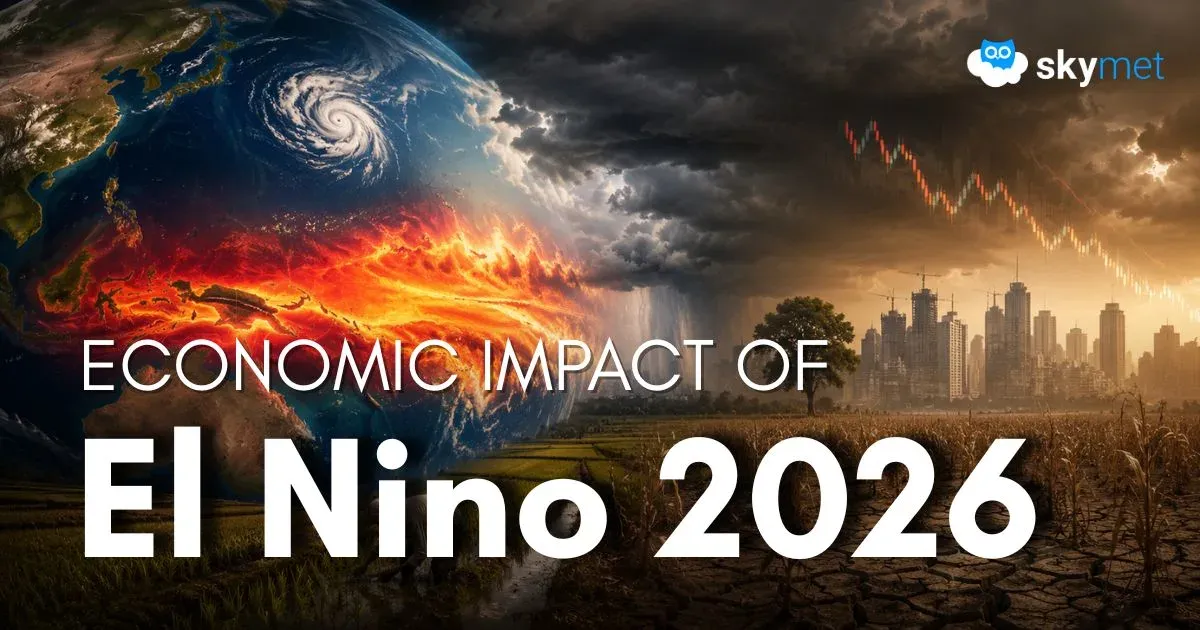
Representational Image: AI-Skymet
Key Takeaways:
- El Niño 2026 is strengthening and may adversely affect India’s monsoon performance
- Agriculture, inflation, energy demand and GDP growth could face pressure during a weak monsoon season
- Rising urban heat and water stress may disproportionately impact vulnerable populations
- India’s early-warning systems and climate adaptation measures will be critical in reducing economic losses
Every few years, the Pacific Ocean stops behaving itself. Trade winds falter. Warm water that should stay locked in the western Pacific sloshes eastward. Sea surface temperatures climb, the atmosphere reorganises, and thousands of kilometres away — over the Deccan Plateau, the Gangetic plains, the rain-fed fields of Madhya Pradesh — the Indian monsoon begins to stutter.
That is El Niño. Spanish for "The Little Boy," a name borrowed from Peruvian fishermen who first noticed unusually warm coastal waters arriving around Christmas. In 2026, El Niño has moved from distant concern to active risk. Conditions have developed across the equatorial Pacific and are expected to strengthen through late 2026.
How El Niño 2026 Evolved: A Skymet Tracker
Skymet's meteorological team, led by AVM GP Sharma, President of Meteorology and Climate Change, has been tracking the ENSO evolution across the equatorial Pacific since early 2026. The weekly progression tells a story of accelerating risk.
Mid-May 2026: Our analysis noted that ENSO-neutral conditions were rapidly dissolving. All four Niño indices in the equatorial Pacific had remained above 0°C since late April. April 2026 sea surface temperatures were reported as the second-highest ever measured. The Niño 3.4 index, the primary marker for the Oceanic Niño Index, was at +0.4°C — not yet at the formal El Niño threshold, but closing in.
More strikingly, the Niño 1+2 region off the Peruvian coast had surged to 1.6°C. Skymet flagged at this stage that the possibility of a “Super El Niño” — a term the media has increasingly adopted for events where temperature anomalies exceed 2°C — could not be dismissed.
Depending on the threshold and dataset used, only a handful of very strong El Niño events have occurred since 1950, including 1982–83, 1997–98 and 2015–16.
Late May 2026: By the week ending May 30, the equatorial Pacific had transitioned decisively toward El Niño conditions. The IRI ENSO forecast assigned a 98% probability of El Niño during May–July 2026 — a figure Skymet noted as a “very rare occurrence that hardly finds any parallel during this century.” Sub-surface ocean temperatures, averaged across the 180°–100°W equatorial band, had risen for six consecutive months.
The basin-wide nature of the warming was significant. Skymet noted that such an event can affect the Indian monsoon, though the final impact depends on the location of warming, IOD, MJO and other factors.
Skymet's assessment: “The El Niño effect is likely to pick up at a faster rate, and the chances of the monsoon being adversely affected are becoming higher.”
Early June 2026: Our latest update as of June 6 confirmed that while the Niño 3.4 index moved slowly, gaining only 0.1°C over four weeks, the Niño 1+2 anomaly off the Peru coast had reached an all-time high of 1.7°C since December 2023.
Complicating the picture: the Indian Ocean Dipole (IOD), which can act as a partial counterweight to El Niño’s suppression of monsoon rainfall, was sitting at -0.43°C — marginally below the negative threshold.
The Madden-Julian Oscillation (MJO), another key driver of intra-seasonal monsoon variability, moved into Phase 8 — a position offering little active support to monsoon advancement. The southwest monsoon has set in over Kerala, but the dual drag of a negative IOD and an out-of-phase MJO may not support accelerated progress.
Skymet has repeatedly noted that El Niño alone does not determine the monsoon outcome; IOD, MJO, Himalayan snow cover and intra-seasonal variability can all alter the final rainfall picture.
What remains uncertain is peak intensity. NOAA CPC’s June 11 update assigns a 63% chance of a very strong El Niño during November–January, while noting that even very strong events do not produce uniform impacts everywhere. During the monsoon months themselves, the event is most likely to range from weak to moderate, with a roughly 40% probability of strengthening toward strong or very strong in September–October.
The media has escalated its language from “El Niño” to “Super El Niño” to — most dramatically — “Godzilla El Niño,” a term that gained currency during the extraordinary 2015–16 event when the Niño 3.4 anomaly peaked above +2.5°C. At Skymet, we do not endorse this terminology. Sensationalised labels may capture headlines, but they obscure the scientific rigour that responsible weather communication demands. El Niño is a complex, multi-variable ocean-atmosphere phenomenon — its severity cannot be collapsed into a pop-culture metaphor.
A Historical Footnote: The Famine of 1876–78 and What We Can and Cannot Conclude
The Great Famine of 1876–78 is frequently invoked in El Niño discussions — and rightly so in terms of its human toll, with an estimated 55 lakh to 82 lakh lives lost across colonial India. However, the El Niño connection must be stated carefully. No agency was tracking Pacific sea surface temperatures in 1876. BoM, CPC, IRI, ECMWF, JAMSTEC — none existed. The link is a retrospective reconstruction, assembled over a century later from ship logs, coral proxy records and extended SST datasets, carrying uncertainty ranges far wider than any modern ENSO event.
The famine remains a legitimate case study in how monsoon failure, compounded by institutional unpreparedness, produces catastrophic outcomes. But presenting 1876 as a confirmed, measurable El Niño comparable to 1997–98 or 2015–16 would overstate what the science supports. At Skymet, we prefer to let the data speak — and on this episode, the data speaks with caveats.
El Niño’s Economic Toll on India
Over the past several decades, roughly 60% of El Niño years have produced drought conditions somewhere across India. The economic logic of how a monsoon deficit translates into broader damage is worth tracing carefully.
Agriculture: The First Domino
The most immediate hit falls on Kharif crops — rice, cotton, soybeans, pulses — sown between June and October and almost entirely dependent on monsoon rainfall. A delayed or deficient monsoon compresses the sowing window, reduces soil moisture at critical growth stages, and slashes yields. When farmers compensate by pumping groundwater, diesel and electricity costs surge. The twin squeeze of lower output and higher input costs destroys profit margins — particularly for small and marginal farmers, who make up the vast majority of Indian agricultural households, and who have the least capacity to absorb losses.
The 2015–16 El Niño offers a recent reference point: India's agricultural growth rate fell to just 0.5% that year, erasing years of incremental gains in a single season.
Agriculture contributes roughly 15% of India's GDP directly, but its multiplier effects through rural consumption, supply chains, and agri-processing are considerably larger.
Agflation: The Inflationary Spiral
When crops fail, food becomes scarce. When food becomes scarce, prices rise. This "agflation" — agricultural inflation rippling through the broader price system — has historically pushed India's food price index into double digits during severe El Niño years.
Because food carries a heavy weight in India's Consumer Price Index basket, even moderate food inflation aggressively erodes household purchasing power. The government's response typically involves dipping into strategic grain reserves and, in severe cases, imposing export restrictions — with direct consequences for global commodity markets given India's position as one of the world's largest rice exporters.
The RBI’s Impossible Position
High food inflation forces the Reserve Bank of India into a macroeconomic corner. Its conventional tool — raising repo rates to cool inflation — works against growth by making credit more expensive for businesses and consumers. Corporate capital expenditure slows. Home loans get pricier. Industrial expansion stalls. The result is the stagflation threat: rising prices coinciding with slowing growth. India's FY27 GDP growth could moderate to around 6.5%, weighed down by agricultural stress, elevated input costs, and geopolitical uncertainties already present in global trade.
Energy and Water: The Hidden Multiplier
Less discussed but equally consequential is El Niño's strain on energy infrastructure. In severe drought years, hydroelectric reservoir levels have fallen below 30% of capacity, forcing costly emergency coal imports precisely when domestic power demand peaks due to record heat. A comprehensive SBI Research report estimated that a severe El Niño season can inflict a direct economic blow of $20–25 billion — combining rural income loss, fiscal drought-relief expenditure, and industrial energy costs.
El Niño and the Urban Heat Island Effect
El Niño does not stop at the farm gate. In cities, it collides with a problem of our own making — unplanned concretisation has replaced soil, trees, and water bodies with asphalt and steel, trapping heat and making urban centres significantly warmer than surrounding rural areas.
When El Niño pushes baseline temperatures higher, this Urban Heat Island effect acts as a dangerous multiplier. The economic cost falls hardest on India's vast informal workforce — construction labourers, street vendors, delivery workers — who have no choice but to work outdoors as productivity falls and workable hours shrink.
The ILO estimates that a 1.5°C rise in global temperatures could eliminate 2.2% of total working hours worldwide by 2030, equivalent to roughly 80 million full-time jobs. In India's heat-exposed cities, the burden is carried most heavily by those least able to adapt — poorer communities in dense slums facing acute heat exposure and worsening water scarcity. El Niño, in this sense, functions as a regressive tax on the urban poor.
Adapting to El Niño’s Threat
1. Strengthen Agricultural Resilience
Accelerate the shift from water-intensive paddy and sugarcane toward drought-tolerant pulses, oilseeds, and millets under ICAR's contingency frameworks. Scale drip and sprinkler irrigation under PMKSY's "Per Drop More Crop" urgently — an El Niño year is precisely when this investment earns its returns.
2. Restore Water and Urban Infrastructure
Mission Amrit Sarovar and Mission Kakatiya carry forward the lesson of the Nizam's tank system — traditional water bodies are proven climate buffers, not heritage projects. Cool Roof policies, wetland restoration, and expanded urban tree canopies must be prioritised to counter the Urban Heat Island effect.
3. Protect Livelihoods and Disseminate Early Warnings
Statutory Heat Action Plans must be enforced with mandated working-hour adjustments and wage-loss protection for outdoor labourers. Early-warning dissemination to smallholder farmers, across regional languages and formats, must be treated as a non-negotiable public good.
Conclusion: The Forecast Is Not Fate
El Niño 2026 is real, strengthening, and consequential. It has the potential to suppress monsoon rainfall, trigger crop stress, fuel agflation, strain the RBI's monetary tools, drive up energy costs, and worsen heat-related economic losses in cities.
But it is not 1876. India has institutions, reserves, early-warning systems, and critically, the knowledge of what to do. The Great Famine was a compound disaster: a climate failure compounded by institutional absence.
Whether El Niño 2026 earns a dramatic moniker, Super El Niño, Godzilla El Niño, matters far less than whether India's institutional response is proportionate to the risk it already poses. At Skymet, we will keep watching the Pacific and updating you every week. The question is whether the response onshore moves at the same pace as the warming offshore.
Sources: Skymet Weekly ENSO Tracker May–June 2026, NOAA CPC ENSO Diagnostic Discussion 11 June 2026, IMD Long Range Forecast 2026, ILO Climate Report, SBI Research, ICAR DACP Framework, Journal of Climate (Huang et al., 2020), NOAA ERSSTv5 Dataset.